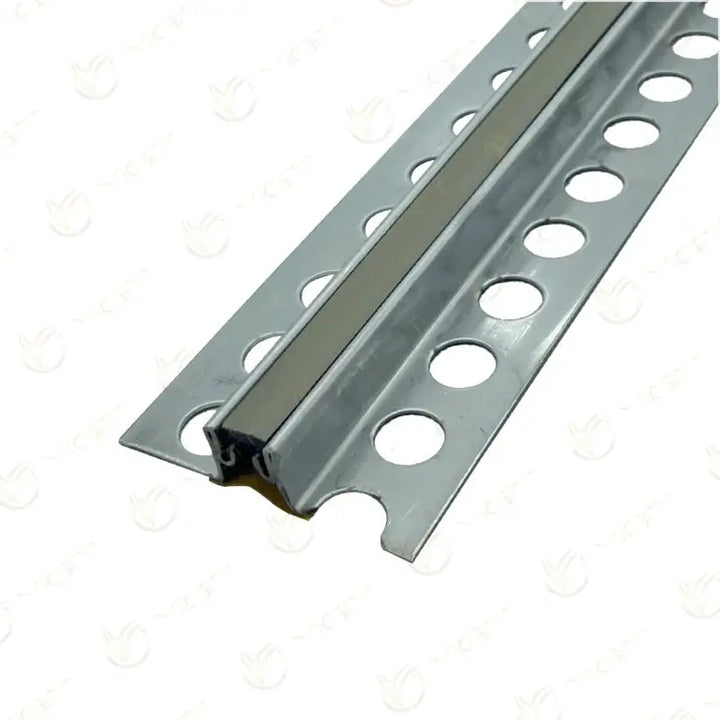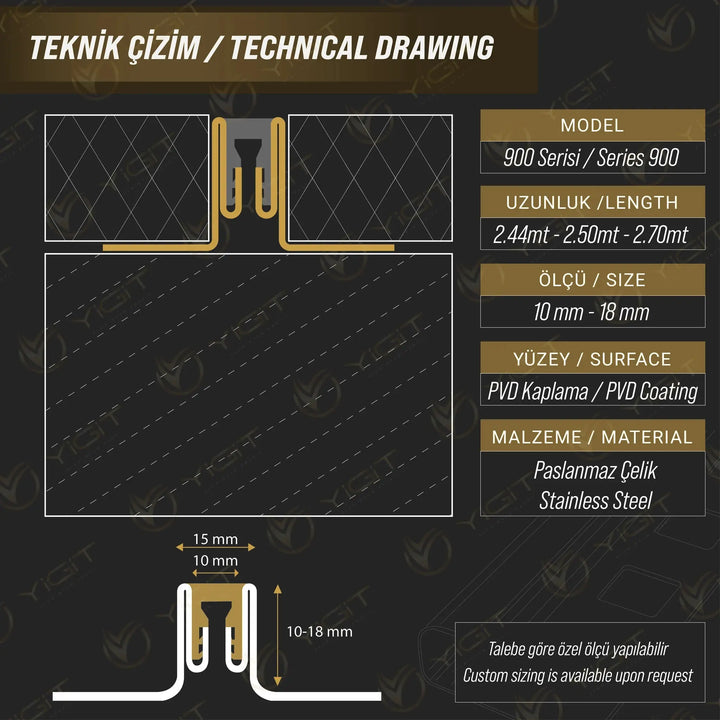


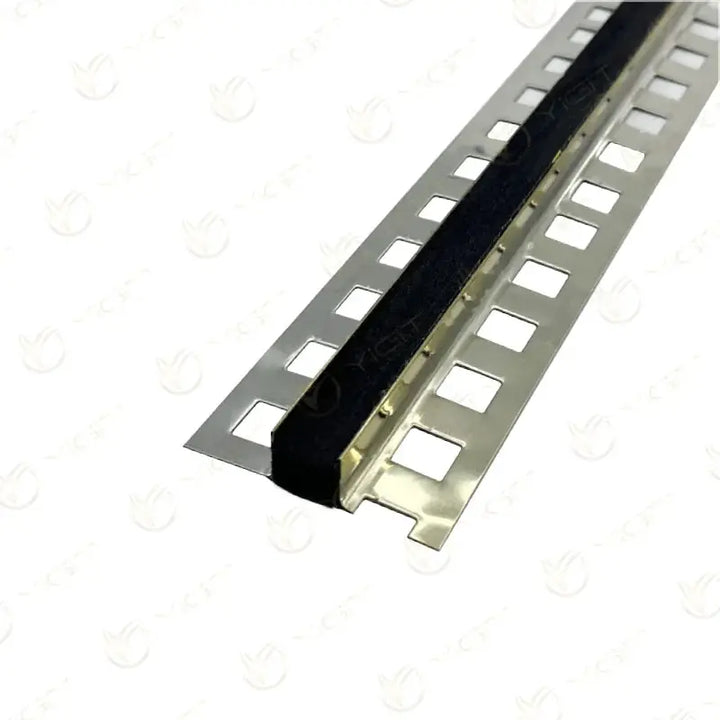
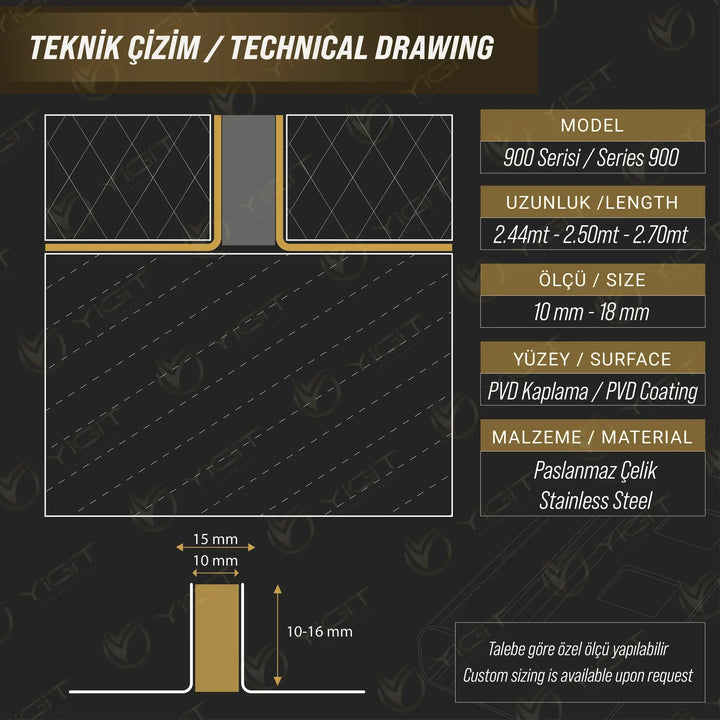
Stainless steel expansion joint profiles organise the edges of a movement joint planned within the covering. The Type 1 and Type 2 models differ in the geometry of their centre sections. The choice should be made by assessing the covering thickness, the joint width and the movement conditions expected by the project together.
Category guide
A stainless steel expansion joint profile is part of the system that defines the covering edges around a movement joint. Whether the joint performs its function depends not only on the metal section but also on the structure of the centre section, the fixings and correct positioning. It should not be treated as serving the same purpose as an ordinary decorative border or a fixed transition section.

The Type 1 expansion joint profile is distinguished in the source image by a flatter-looking centre section. Its edge flanges and its relationship to the covering are reviewed from the section.
The Type 2 expansion joint profile differs in the inward-turning geometry of its centre section. No numerical movement capacity or material composition can be inferred from this shape.
Take the expected amount and direction of movement from the project. The suitability of the selected model must be verified with the technical documentation.
Assess the joint width, the covering height and the fixing flanges together.
Check the actual material of the flexible part, the environment of use and the maintenance conditions for the model.
Review how the joints in the covering and the underlying layers relate to the project detail. Avoid any fixing that restricts movement.
The stainless steel movement joint profile is considered for organising the dividing line in tile and similar coverings. Where there is heavy use, cleaning or special environmental conditions, the technical suitability of the model is assessed separately. The type number should not be interpreted as a performance ranking.
The joint line is marked according to the installation drawings. The profile flanges and the covering edges are matched to the finished level. The movement space of the centre section must not be closed off with rigid filler or an incorrect fixing. The installation is completed in accordance with the system instructions for the selected product.
Determine the function of the joint; compare the covering and the profile section against the finished surface dimensions.
We use only essential cookies, which are needed for the site, the cart and your order to work. For details, see: Cookie and Explicit Consent Notice